


RIO LINDA, CA – In a powerful demonstration of community unity and the strength of local advocacy, the Sacramento County Planning Commission voted on Monday night to uphold the residents’ vision for Rio Linda. The Commission moved to recommend denial of a request to convert the long-awaited “Chandra Commons” project from owner-occupied condominiums into a high-density rental apartment complex.
The decision is being hailed as a major victory for the Rio Linda/Elverta community, proving that the unanimous voice of the local Community Planning Advisory Council (CPAC) remains a force to be reckoned with at the county level.
A Promise Made in 2007
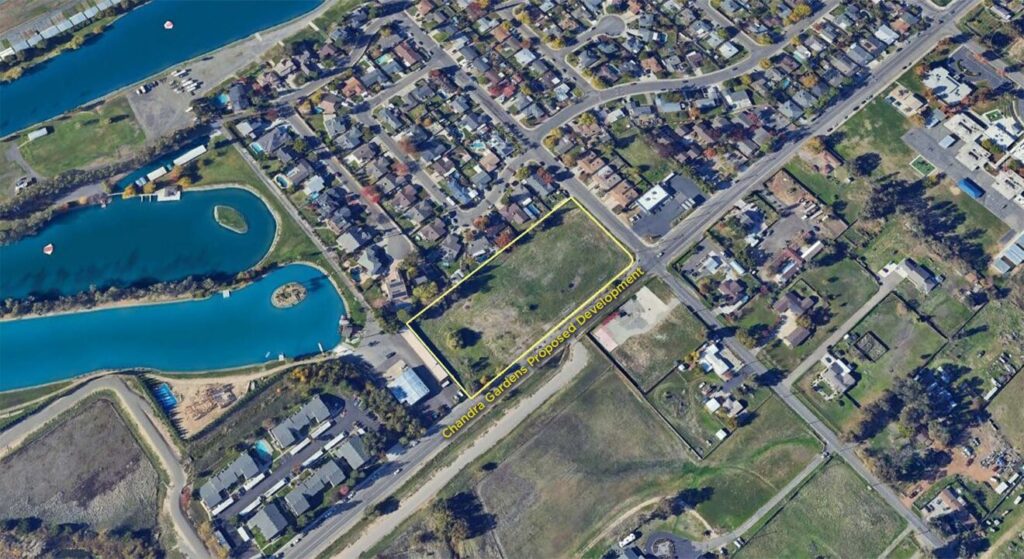
The battle centered on a vacant lot at the southwest corner of Dry Creek Road and ‘E’ Street. In 2007, a specific Zoning Ordinance (SZC-2007-0015) was passed that allowed for development on the site, but with two “iron-clad” conditions designed to protect the rural-residential character of Rio Linda:
- The units had to be “for-sale” condominiums (owner-occupied).
- The project had to adhere to a specific, high-quality architectural design.
For nearly 20 years, those conditions stood as a safeguard. However, the current developers, represented by Lad Wentzel and Ivan Sanchez, returned to the County seeking to strip those protections away. They argued that today’s economy and high interest rates made “for-sale” units unfeasible, asking instead to build “Chandra Commons” as a standard rental apartment complex with updated, modern (and some argue, simplified) designs.
The CPAC Line in the Sand
The momentum for Monday’s victory began on September 24, 2025, when the Rio Linda/Elverta CPAC met to review the developer’s request. In a rare and powerful showing of solidarity, the council voted 5-0 to recommend denial.
The CPAC’s message was clear: Rio Linda is a community of stakeholders and homeowners. The “for-sale” condition was not a suggestion; it was a hard-fought compromise to ensure that whoever lived at Dry Creek and ‘E’ Street would have a literal “investment” in the neighborhood’s future.
Residents Speak Truth to Power
At Monday’s Planning Commission hearing, the local contingent made sure the voices of Rio Linda were heard loud and clear.
Charlea Moore, a tireless advocate for the community, reminded the Commission of the history behind the 2007 ordinance. She argued that the community specifically negotiated for homeownership to ensure property maintenance and long-term stability. She also highlighted the glaring lack of infrastructure—specifically sidewalks and lighting on ‘E’ Street—that would make a high-density rental complex a safety hazard for pedestrians.
Tabitha Worth echoed those safety concerns, pointing to the existing congestion at the Dry Creek intersection, while Cathy DeLeon took aim at the developer’s rationale, stating that a developer’s profit margin should not come at the expense of the community’s quality of life. Susie Gerkensmeyer further warned that approving this change would set a dangerous precedent, essentially telling developers they can ignore community-negotiated conditions whenever it becomes “inconvenient” for their bottom line.
The Commission Deliberates
The Planning Commissioners seemed moved by the community’s consistency. Commissioner Mike Rockenstein led the discussion by questioning the fairness of stripping away community protections established decades ago.
Vice Chair Joseph Devlin and Commissioner Mariana Corona-Sabeniano pushed back on the developer’s claims of economic hardship. The Commission noted that while the market is indeed difficult, the developer failed to prove that a “for-sale” project was impossible—only that it was currently less profitable than a rental model.
Ultimately, Chair Jofil Borja pointed to the CPAC’s unanimous 5-0 vote as a deciding factor. He noted that the local advisory board is the Commission’s “boots on the ground,” and their absolute consensus indicated a fundamental mismatch between the proposal and the town of Rio Linda.
What This Means for Rio Linda
The Planning Commission’s recommendation for denial now moves to the Sacramento County Board of Supervisors for a final vote. While the battle isn’t over, this recommendation is a massive hurdle for the developer and a significant validation of our local “watchdog” efforts.
This victory belongs to every neighbor who attended a meeting, wrote a letter, or spoke at a podium. It reinforces that Rio Linda is not just a place on a map for developers to exploit—it is a community with a specific identity, a long memory, and a resident base that will fight to protect its rural-residential heart.
Stay tuned to Rio Linda Online for updates on the final Board of Supervisors hearing date. Together, we keep Rio Linda, Rio Linda.
Post Views: 0
