

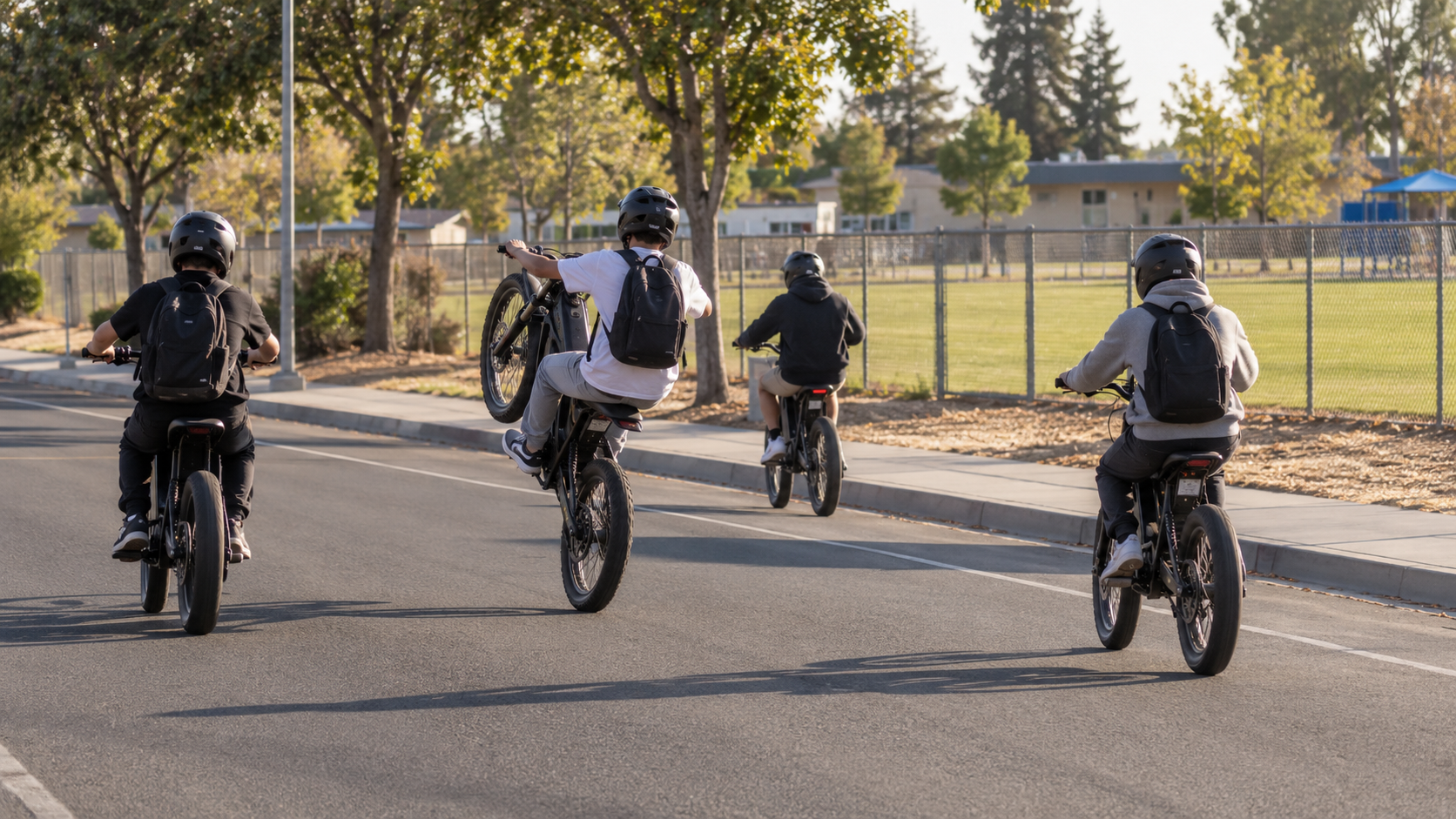

As electric bicycles become more common on local streets and trails, riders and parents need to understand the difference between a legal e-bike and an electric motorcycle.
By John Todd | Rio Linda Online
Electric bicycles have become a familiar sight throughout Rio Linda, Elverta and the rest of Sacramento County.
Students ride them to school. Adults use them for commuting and errands. Families take them onto neighborhood streets, bike paths and recreational trails.
But as e-bikes become faster and more common, the line between a legal electric bicycle and an electric motorcycle has become increasingly important. Sacramento County has strengthened its enforcement authority, particularly along the American River Parkway, while California law places different restrictions on riders depending on the type of bicycle they operate.
The subject will soon receive local attention as well. The Rio Linda Elverta Neighborhood Association is working to bring representatives from the California Highway Patrol and Sacramento County Regional Parks Rangers to Rio Linda to discuss e-bike safety, classifications and enforcement.
The next RLENA meeting is scheduled for Thursday, September 17. Additional information about the planned e-bike discussion will be announced as participation by the agencies is confirmed.
For parents and riders, the first question should be simple: What exactly are you riding?
California’s three e-bike classes
Under California law, a legal e-bike must have fully operable pedals and an electric motor rated at no more than 750 watts. The state divides those bicycles into three classes:
- Class 1: The motor provides assistance only while the rider is pedaling and stops assisting at 20 mph.
- Class 2: The motor can propel the bicycle without the rider pedaling, usually through a throttle, but assistance stops at 20 mph.
- Class 3: The motor assists only while the rider is pedaling and stops assisting at 28 mph. Riders must be at least 16 years old, and everyone riding a Class 3 e-bike must wear a helmet.
California also requires anyone younger than 18 to wear a properly fitted and fastened helmet while riding any bicycle or e-bike on public roads, bikeways and public bicycle paths or trails.
Legal e-bikes generally do not require DMV registration, a license plate or a driver’s license. Those exemptions may disappear, however, when a vehicle exceeds the legal limits established for an electric bicycle.
When an “e-bike” is really an electric motorcycle
Some electric two-wheelers are marketed or casually described as e-bikes even though they can travel well beyond legal e-bike speeds or have motors exceeding 750 watts.
Others have motorcycle-style seats, throttles and foot pegs but no operable pedals. These machines may be electric motorcycles or another type of motorized vehicle rather than bicycles.
A vehicle without fully operable pedals is not a legal e-bike. But pedals alone do not automatically make it one. Its motor output, assisted speed, equipment and manner of operation also determine how it is classified.
That difference matters. A vehicle classified as a motorcycle or motorized bicycle may require registration, an appropriate driver’s license, approved safety equipment and insurance. It may also be prohibited from bike paths and trails where ordinary bicycles and some classes of e-bikes are allowed.
Parents shopping for a child should check the manufacturer’s classification label and specifications instead of relying only on the appearance of the vehicle or language used in an advertisement.
Sacramento County strengthens enforcement
Concerns about speeding, reckless riding and electric motorcycles entering bicycle-only areas have been especially visible along the American River Parkway.
The paved trail is shared by pedestrians, runners, conventional cyclists, equestrians and other recreational users. All can be placed at risk when heavier electric vehicles travel at motorcycle-like speeds through crowded areas.
On May 12, the Sacramento County Board of Supervisors unanimously approved ordinance changes intended to protect parks, recreation facilities and environmentally sensitive land from unauthorized electric and motorized vehicles.
The changes strengthened the county’s ability to address Class 3 e-bikes, electric motorcycles, dirt bikes and similar vehicles in prohibited areas. They also gave Sacramento County Regional Parks additional authority to respond to unauthorized jumps, tracks and bicycle courses constructed in natural areas.
Class 3 e-bikes and electric motorcycles are prohibited on the American River Parkway trail. Violations of county ordinances may be prosecuted as infractions or misdemeanors, depending on the offense and circumstances.
County park rangers have already conducted targeted enforcement operations along the Parkway. During a June operation, officials reminded riders that the trail’s posted 15-mph speed limit applies regardless of how fast a bicycle is capable of traveling.
The county’s stated goal is not to discourage e-bike use. It is to keep high-speed and improperly classified vehicles out of areas where they create a danger to other trail users.
Rules worth following everywhere
Although some regulations are specific to the American River Parkway, the underlying safety practices apply on trails, neighborhood streets and roads throughout Rio Linda and Elverta:
- Obey posted speed limits. The American River Parkway trail limit is 15 mph for every rider.
- Ride in the same direction as traffic and obey stop signs, signals and right-of-way rules.
- Pass other trail users on the left and provide an audible warning before passing.
- Ride single file when conditions require it.
- Slow down around pedestrians, children, animals and congested areas.
- Remain alert and avoid distractions.
- Pull completely off the trail before stopping.
- Stay on trails and routes where bicycles and your particular class of e-bike are permitted.
- Use proper lighting and reflectors when riding after dark.
- Wear a helmet—even when the law does not require one.
Local meeting planned as concerns grow
The Rio Linda Elverta Neighborhood Association’s effort to bring CHP and Sacramento County Regional Parks Rangers to Rio Linda would give local families an opportunity to hear directly from the agencies responsible for roadway and trail enforcement.
Representatives would be able to explain the differences between legal e-bikes and electric motorcycles, where each class may be ridden, helmet and age requirements, and the potential consequences when riders ignore traffic or trail regulations.
The next RLENA meeting is scheduled for Thursday, September 17. Rio Linda Online will share further information about the meeting and participating agencies as details are confirmed.
E-bikes can provide young people and adults with affordable transportation, greater independence and another way to enjoy the outdoors. Their growing popularity also places greater responsibility on riders and parents to understand what these machines can do and where they legally belong.
Before riding—or handing an e-bike to a child—know its classification, motor output, maximum assisted speed and the rules governing where it may be operated.
Additional information is available through Sacramento County’s e-bike safety guide, its updated parks ordinance and the partial California Highway Patrol guide to motorcycles and similar vehicles.
Post Views: 4
