

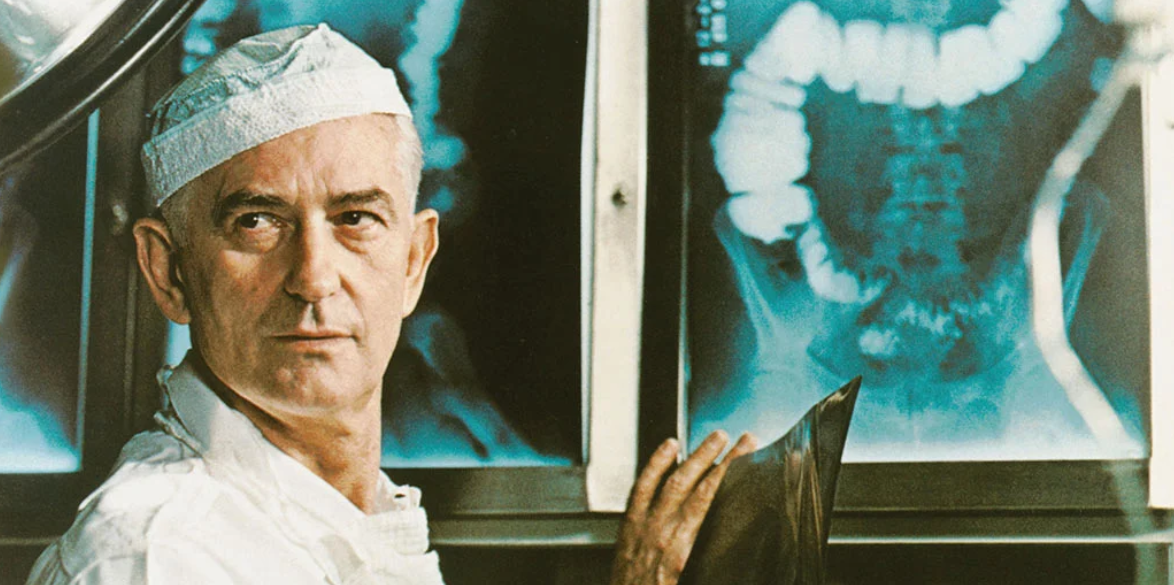

In 1972, Rio Linda fought to bring a young doctor to town. In 2026, the community has no primary-care physician and, following Rite Aid’s closure, no pharmacy.
By John Todd | Rio Linda Online
In August 1972, a newspaper article carried the headline “A Challenge in Rio Linda.”
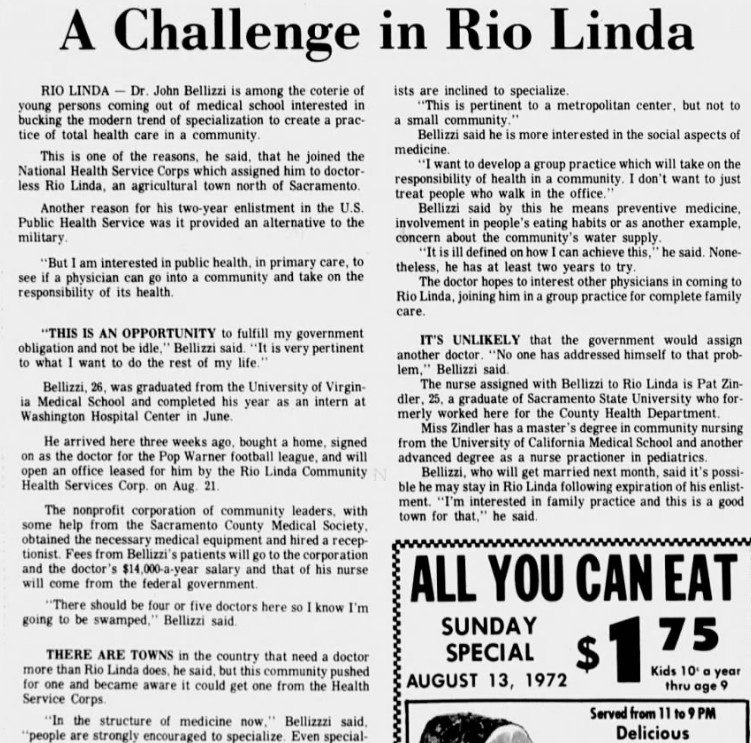
The challenge was bringing medical care to a growing rural community that needed more doctors.
Dr. John Bellizzi was 26 years old, recently graduated from the University of Virginia Medical School and had just completed an internship at Washington Hospital Center. Through the National Health Service Corps, he agreed to spend two years practicing medicine in Rio Linda.
Bellizzi had arrived only three weeks before the article was published. He purchased a home, signed on as the doctor for the Pop Warner football league and prepared to open an office leased by the nonprofit Rio Linda Community Health Services Corporation.
The community did not simply wait for someone else to solve its problem. Local leaders organized, worked with the Sacramento County Medical Society, found office space and recruited a young doctor interested in family medicine and public health.
“There should be four or five doctors here, so I know I’m going to be swamped,” Bellizzi told the newspaper.
More than half a century later, Rio Linda would be grateful to have even one.
From Too Few Doctors to No Doctor at All
Rio Linda’s last general-practice doctor left decades ago. Today, there is no traditional primary-care physician’s office or family medical clinic serving the general public within the community.
There are dentists, an optometrist and a specialized residential mental-health program. Those are valuable services, but they are not replacements for a neighborhood doctor who can perform routine examinations, treat illnesses, monitor chronic conditions, provide vaccinations and refer patients to specialists.
Now the community has lost its pharmacy as well.
The closure of Rite Aid at 6420 Rio Linda Boulevard eliminated the only full-service pharmacy in Rio Linda. Residents who need prescriptions filled, pharmacist consultations, vaccinations or common medical supplies must travel to North Highlands, Antelope, Natomas or elsewhere in the Sacramento region.
For residents with reliable transportation and flexible schedules, that trip may be inconvenient. For seniors, people with disabilities, residents without cars and families trying to manage work and school schedules, it can become a genuine barrier to care.
Rio Linda and Elverta have effectively become a health-services desert.
The Same Needs Bellizzi Identified in 1972
What makes the old article especially striking is how closely Bellizzi’s ideas match what Rio Linda needs today.
Bellizzi told the newspaper that he was not interested in simply treating people who walked into his office. He wanted to develop a group practice that would take responsibility for the health of the entire community.
He spoke about preventive medicine, nutrition, water quality and the broader social conditions affecting health. He hoped other doctors would join him to provide complete family care.
“This is pertinent to a metropolitan center, but not to a small community,” Bellizzi said of the medical profession’s growing emphasis on specialization.
That distinction remains relevant in 2026.
Rio Linda does not necessarily need a large specialty hospital. It needs basic, dependable and accessible care: a family doctor, nurse practitioners, a walk-in or urgent-care clinic, preventive health services, pediatric care and a pharmacy.
A modern community health center could also offer laboratory services, vaccinations, behavioral-health support, telehealth rooms and assistance connecting residents with specialists outside the area.
These are not luxuries. They are the front door to the health-care system.
A Need the Community Repeatedly Identifies
Whenever Rio Linda and Elverta residents are asked what businesses or services they want to see in the community, medical care is nearly always part of the conversation.
The request comes up during community meetings, discussions about economic development and debates over what should replace vacant commercial buildings. Residents ask for a doctor’s office, urgent-care center or pharmacy because they are tired of leaving town for services that most communities consider fundamental.
The former Rite Aid property illustrates both the problem and the opportunity.
At approximately 6420 Rio Linda Boulevard, the building sits near the center of the community and previously housed the pharmacy residents depended upon. Whatever ultimately occupies that property, Rite Aid’s departure has made the absence of local health care more visible.
The loss also extends beyond prescription pickup. Community pharmacies often provide immunizations, medication advice, blood-pressure checks and immediate access to a health professional who can answer basic questions. For some residents, the pharmacist was the most readily available medical professional in town.
That connection is now gone.
Health Care Requires Transportation
Official health-provider directories can give the impression that Rio Linda residents have plenty of options because dozens of doctors and hospitals exist within several miles of the ZIP code.
Distance on a map does not tell the entire story.
Rio Linda does not have the same freeway access, public transportation frequency or concentration of medical offices found in more developed parts of Sacramento County. A resident may have to take multiple buses or arrange a ride simply to attend a routine appointment.
The nearest major hospital listed by Healthgrades is Mercy San Juan Medical Center in Carmichael, approximately seven miles away. Other primary-care and urgent-care options are scattered through North Highlands, Natomas, Antelope and Sacramento.
Those facilities may be geographically close, but they are not located in the community—and they are not equally accessible to everyone.
A local clinic would allow residents to seek care earlier instead of postponing treatment until a condition becomes more serious. It would make follow-up visits easier, improve access to preventive care and reduce the transportation burden on families and older residents.
Rio Linda Solved This Problem Once
The 1972 article offers more than a nostalgic look at a young doctor arriving in town. It provides a model of what community action can accomplish.
The Rio Linda Community Health Services Corporation was created by local leaders with assistance from the Sacramento County Medical Society. Patient fees supported the nonprofit, while federal funding through the National Health Service Corps helped pay Bellizzi’s salary.
The arrangement recognized something that remains true today: communities with limited medical services often cannot recruit providers by relying on the private market alone.
Rio Linda may again need a partnership involving Sacramento County, a nonprofit community health organization, a hospital system, the National Health Service Corps or a federally qualified health center.
County leaders could help identify available buildings, pursue grants and recruit an established medical organization willing to open a satellite clinic. Property owners and developers could make space available for a medical tenant. Residents and community organizations could document demand and make health services a stated economic-development priority.
The community should not have to start from nothing. Sacramento County has health systems and nonprofit providers already serving neighborhoods with limited access to care. The question is whether any of them—and the public officials responsible for representing Rio Linda and Elverta—are prepared to make this community a priority.
The Challenge Before Rio Linda
In 1972, Bellizzi believed one doctor would not be enough.
He was right.
But one doctor was a beginning. His arrival meant local children, working families and older residents had someone nearby to call when they were sick. It meant the community had a medical professional who understood Rio Linda as more than a location on a chart.
In 2026, even that beginning is gone.
Rio Linda has grown, the population has aged and medical care has become more complicated and expensive. Yet the community has fewer basic health resources within its boundaries than it had more than 50 years ago.
The challenge in 1972 was recruiting additional doctors to serve Rio Linda.
The challenge in 2026 is convincing Sacramento County, health-care organizations and potential providers that a community of this size should not be expected to live without a doctor or pharmacy at all.
Medical care is one of the services residents request every time they are asked what Rio Linda needs.
It is time for that answer to be treated as more than a suggestion.
Post Views: 8
